Integrating a Set of Isometric Plastic Food Trays into Your Project Toolkit
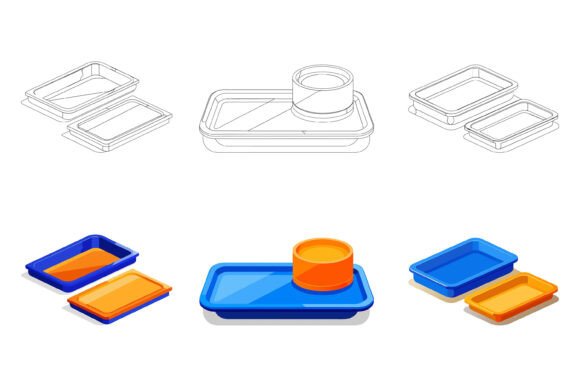
A collection of isometric plastic food tray illustrations might seem like a niche asset, but for anyone working in visual communication—whether you are a graphic designer, marketer, small business owner, or educator—these ready-made vector graphics remove hours of tedious drawing and open up faster, more flexible ways to communicate food-related ideas. The set comes in AI, EPS, and JPG formats, fully editable and built to work on both Mac and Windows systems, making it a practical addition to a broad range of creative workflows.
Where Isometric Food Tray Graphics Fit in the Creative Process
Isometric illustrations offer a clean, dimensional look that sits between flat icons and realistic photography. A set of plastic food trays drawn in this style can be used early in a project—during mood boards or client pitch decks—to convey packaging concepts without the cost of a photoshoot. As the project moves forward, the same assets can evolve into final artwork for menus, websites, infographics, or printed flyers. Because the files remain editable, the visual direction can adapt as decisions get refined, without needing to recreate assets from scratch.
In practice, you might begin by placing the raw tray illustrations into a wireframe to discuss layout options with a client. Later, you can recolor a container to match a brand palette, add a logo, or combine it with other food icons to build an entire takeout menu. The consistency of the isometric perspective across all trays ensures that no matter how many variations you use, the end result looks cohesive.
Preparing Your Workspace for Vector Illustration Sets
Before dragging assets into a layout, a few preparation steps keep the process smooth. The file structure of this particular collection is neatly organized with labeled layers and grouped objects, so your first task is simply to unzip the downloaded package and note the three file types inside. For most design tasks, you will rely on the AI or EPS versions. If you need a quick placeholder or a raster reference, the included high-resolution JPG files are immediately usable.
On a Mac or Windows machine, Adobe Illustrator is the natural home for editing. If you work with alternative vector software like Affinity Designer or CorelDRAW, the EPS format ensures broad compatibility. Opening the file reveals a clean layer hierarchy: trays, shadows, and background elements are often separated, allowing you to toggle visibility and make focused edits without hunting through a deep object stack.
Customizing the Trays to Match Your Brand or Project
The real power of these assets lies in their editability. A standard black plastic tray can be recolored in seconds to match a company’s signature orange or a seasonal pastel theme. Because the illustrations are built with flat shapes and subtle gradients, you can apply new color fills globally or selectively change compartments to indicate different food items. Even structural details—like the depth of the tray, the number of dividers, or the rim style—can be modified if you have basic vector editing skills.
This flexibility means the set can support a wide range of brand identities without looking like generic clip art. For a café chain, you might customize each tray to reflect the exact serving containers they use. For a nutrition blog, you could recolor compartments to represent macronutrient portions. The consistent detailing across every tray keeps the entire set looking like it was drawn specifically for your project.
Practical Applications Across Industries and Platforms
A set of isometric plastic food trays fits naturally into several professional scenarios. In print, they shine on takeout menus, food packaging mockups, catering brochures, and event flyers. Their isometric angle adds depth without the bulk of 3D rendering, making a simple promotional card feel more polished. For digital use, the same illustrations work as hero images on a food delivery website, as icons in a mobile app, or as engaging elements in social media posts that need to stand out in a scrolling feed.
Educators and instructional designers can incorporate the trays into e-learning materials about portion sizes, meal planning, or food safety. Small business owners can use them to mock up new product lines before investing in professional photography. Because the vectors scale infinitely, you can reuse a single tray design as a tiny app symbol or blow it up to banner size without losing quality.
Streamlining Workflows with Organized Layer Structures
One of the most underrated efficiency features in an illustration set is how the file is organized. Instead of receiving a flat, messy artboard, this collection arrives with neatly assigned layers and well-named groups. That might not sound dramatic, but in a time-sensitive project, being able to locate and adjust the shadow layer of a tray in three clicks instead of thirty adds up.
When you need to present multiple tray options to a client, organized layers let you quickly create variations by duplicating artboards and turning layers on or off. You can generate a clean version with no shadows for a minimal print style, or a fully detailed one for an interactive digital catalog, all from the same source file. This layer discipline also makes it easier to hand off the file to a teammate who can instantly understand the structure and continue editing without confusion.
Ensuring Quality and Long-Term Usability
Stock illustration sets can vary widely in quality; some suffer from rough curves, inconsistent lighting, or low-resolution embedded elements. The detailing in a well-built isometric tray set addresses these concerns at the start. Clean anchor points, uniform stroke weights, and carefully placed highlights create a professional finish that holds up even when printed at large sizes. Since the assets are vector-based, you never worry about pixelation. For those who only need a quick raster image, the included JPG versions offer a reliable fallback with consistent resolution.
Thinking long term, editable EPS and AI files mean these trays remain useful for years. As your brand evolves or your software updates, you can return to the original vectors and adapt them. The time invested in learning how to tweak the illustrations pays off when a future campaign needs a slightly different tray style but you do not want to commission new artwork.
Steps to Integrate These Assets into a Typical Project
There is no rigid workflow that every project must follow, but a flexible sequence can help you move from idea to finished output without stumbling over the technical details. Start by identifying the exact role the tray will play: is it a central hero graphic, a supporting icon, or part of a larger packaging diagram? Then choose the version (AI for heavy editing, JPG for a fast composite) and drop it into your workspace.
- Open the EPS file in your preferred vector editor and save it as a working copy to avoid overwriting the original.
- Examine the layers. Turn off any elements you do not need immediately, such as background shapes or inner highlight groups.
- Adjust colors using global swatches or direct fills to match your project palette. Test a few options quickly by duplicating the artboard.
- If combining multiple trays, group each one into a separate symbol or component. This keeps your layout organized and allows instant updates across all instances.
- Integrate the tray with other design elements—text, product images, icons—while respecting the established isometric angle for spatial consistency.
- Export the final graphic in the required resolution and format. For print, use PDF or TIFF; for web, use SVG or PNG.
This sequence is not a rigid checklist but rather a habit that transforms a stock illustration from a static download into a fully integrated part of your visual communication toolkit.
Tips for Collaborative and Multi-Platform Projects
When multiple people touch a design file, consistency becomes a challenge. Because the layer structure in this set is straightforward, you can share the AI file with a colleague and they will see the same organized view. Document a quick naming convention for custom colors or additional elements added to the file to keep things tidy. If a team member does not have a vector editor, you can export specific tray variations as high-resolution PNGs or SVGs that they can use in presentation tools like PowerPoint or Canva without losing quality.
Cross-platform concerns are minimal. The EPS format has been a reliable exchange standard for decades, and both Mac and Windows versions of major design applications handle it well. The JPG files serve as immediate cross-device references that can be viewed on any phone, tablet, or computer without special software, smoothing communication with non-designer stakeholders.
Maximizing Value for Different User Roles
A small business owner running a ghost kitchen can use the tray illustrations on a digital menu board without needing to hire a designer for every promotional update. A food blogger can build a consistent template for recipe cards where each tray becomes a serving-size guide. Marketing teams inside larger food brands can inject the isometric trays into internal presentations to prototype packaging concepts rapidly before engaging an external agency.
Educators teaching food technology or design principles can use the assets as a teaching tool: students can practice re-coloring vector objects, understanding layer logic, and outputting files for different media. The organized file structure becomes a learning aid in its own right, demonstrating professional organization standards.
Avoiding Common Pitfalls When Using Stock Illustrations
The biggest risk when adding any premade graphic to a project is that it will look out of place. To avoid that, always invest time in customization. Even a simple color adjustment and a reworked shadow can make a tray feel native to your brand. Another trap is misusing file formats—printing a low-resolution JPG instead of the vector version—so check your export settings based on the final medium.
With an editable set like this, you are not locked into a single visual style. You can remove elements, add labels, change the viewpoint slightly (with some manual tweaking), and combine trays to create new container arrangements. The more you treat the illustrations as raw material rather than finished art, the more distinctive your final designs become.
Expanding Your Visual Library for Efficiency
A single well-organized illustration collection can spark a broader system. Once you have successfully integrated the isometric food trays into a menu or an app interface, you might start building a library of coordinated assets—sauces, drinks, utensils—that share the same perspective and level of detail. Because this set provides a clean foundation, it sets a quality benchmark for any additional elements you create or purchase later, making future design projects faster and more cohesive.
The combination of AI EPS vector precision, a thoughtful layer structure, and cross-platform reliability makes the Set of Isometric Plastic Food Trays a solid building block in any visual communicator’s collection. Its real strength shows in process: you move from concept to client-ready work with fewer technical distractions, maintaining both creative control and professional consistency.