Old Parents and Children Having Fun: Turning Simple Moments Into Lasting Memories
It starts with a laugh you haven't heard in years. Maybe your dad is trying to figure out a video game controller, his thumbs fumbling over buttons while your teenager gently corrects him. Maybe your mom is in the kitchen, flour dusting her cheeks as she teaches your six-year-old the exact way she kneads dough — a method you remember from your own childhood. These aren't staged photo shoots. They're real, slightly messy, deeply human moments that reframe what it means to grow older within a family. Old parents and children having fun isn't about pretending age doesn't exist. It's about rediscovering each other when routines, distance, and the sheer speed of life have pulled you apart.
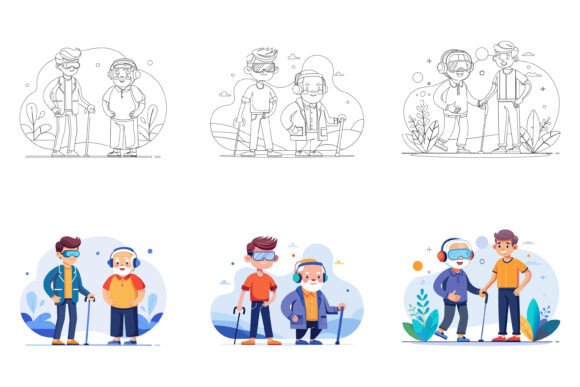
Professionals who work with visual storytelling — illustrators, graphic designers, app developers, marketers at senior living communities — often hunt for imagery that captures this specific warmth without falling into cliché. The challenge is finding assets that feel genuine, not like stock photos of silver-haired models high-fiving in a sterile park. That’s where a carefully crafted AI EPS illustration set can shift the entire tone of a project, offering something adaptable, emotionally accurate, and technically robust.
Why We Overlook Play Between Older Adults and Kids
In many cultures, aging is framed as a slow retreat from vitality. But the reality is far more dynamic. A grandfather teaching chess strategy to his grandson over hot chocolate isn't "cute" — it's a transfer of patience, logic, and quiet connection. A grandmother and her adult daughter laughing uncontrollably while trying to assemble flat-pack furniture showcases resilience and shared absurdity. These scenes deserve more than generic visual representation.
When families or organizations communicate about intergenerational activities, they need imagery that respects the intelligence and spirit of older adults. Condescending visuals — overly simplified, cartoonish, or drenched in pity — do real damage. The right illustration captures dignity alongside delight. For content creators, that means looking beyond the obvious and finding vector art that shows people, not age brackets.
1. Healthcare and Well-Being Communication
A public health campaign promoting mental stimulation for seniors might use a illustration of a grandmother doing a puzzle with her granddaughter. But if the art feels cold or institutional, the message falls flat. When a designer downloads an AI EPS and JPG bundle that’s neatly organized, file, and layer structure, they can instantly adjust colors to match a warm, accessible palette. Maybe the original artwork has cool blues; shifting to soft terracotta and sage green immediately makes the scene feel like a real living room. This small edit helps a brochure for a memory care program feel less clinical and more human.
Hospitals use these assets in patient education too. A flyer explaining the benefits of walking groups for older adults becomes infinitely more inviting when it includes an illustration of an older father and his adult child speed-walking together, smiling genuinely, not posed stiffly for a camera. The perfection in details and consistency across the set means the same characters can appear in different poses across multiple materials, building a visual narrative.
2. Tech Apps That Bridge Generations
App developers face a tricky balance. Build an interface for seniors, and it must be clear, large, and jargon-free. Design it for grandchildren, and it needs snappy microinteractions and modern iconography. When the app’s purpose is to connect both generations — say, a photo-sharing platform or a virtual game night tool — the onboarding illustrations matter enormously.
Here, a versatile EPS collection becomes a practical asset. Since you can edit it, change colors and modify the icon so easily according to your needs, a developer can take an illustration of a grandmother and child playing cards and recolor the table, the background, even the characters' clothing to align with the app’s brand identity. Because the files are designed for Mac and Windows users, cross-team collaboration is frictionless. The suitable for print, web, symbols, apps, infographics flexibility means the same grandmother-and-grandson pair can appear in the app store preview, the onboarding screens, and a printed quick-start guide without visual inconsistency.
3. Community Centers and Nonprofit Storytelling
A small nonprofit running an intergenerational gardening program has zero budget for custom illustration. Yet they need a website, social media posts, and event flyers. A ready-made illustration set that includes AI EPS and JPG formats saves them from the visual disaster of stretched, pixelated clipart. Because the layers are organized intelligently, a volunteer with basic vector skills can isolate the grandmother and child watering plants, remove the background, and float them onto a custom header image. This kind of practical usefulness transforms a $25 purchase into a foundation for an entire campaign.
The emotional resonance here is subtle but powerful. When potential donors see an old parent and a child having fun — genuinely, not performatively — they associate the nonprofit with dignity and joy. That emotional thread often converts curiosity into donations.
4. Publishing and Editorial Projects
Magazine art directors and book cover designers constantly seek illustrations that suggest layered human relationships. A feature on modern grandparenting doesn't need a photo of a specific family; it needs a universal image that feels fresh. An illustration of an older woman and a young adult flying a kite, depicted with perfection in details and consistency, offers exactly that. The designer can easily modify the line art to match the publication’s visual style, maybe converting a colorful vector into a duotone spot illustration by editing fills in seconds.
Even in digital publishing, load speed and scalability matter. JPGs serve quick previews, while the EPS files nestle into InDesign layouts for crisp print output. This dual-format approach, bundled thoughtfully, reflects how real publishing workflows operate.
Practical Strengths That Go Beyond the Obvious
When someone buys an illustration set featuring old parents and children having fun, they usually arrive with a specific mental image: a picnic scene, perhaps, or reading a book. But a well-built collection surprises them with versatility. The same core characters might appear in multiple activities — cooking, gardening, playing music, walking a dog. This consistency means a brand can build a recognizable visual language across touchpoints. A senior travel agency could feature the same father-daughter duo exploring a market in one brochure and riding bicycles in another, strengthening emotional continuity.
The technical organization matters enormously in tight-deadline environments. Neatly organized, file, and layer structure doesn’t just sound tidy; it means a motion designer can animate the grandfather’s arm raising a kite without untangling a mess of grouped vectors. It means a UI designer can export the grandfather’s face as a standalone icon for a profile avatar. These are real-world workflow accelerators that save hours of frustration.
Nuances to Keep in Mind
No stock illustration, however beautiful, captures every cultural nuance. Families look different across the globe, and while a set may offer diversity in skin tone and age, a designer might still need to adjust features, attire, or body language. The ability to change colors and modify the icon so easily according to your needs becomes a bridge for cultural adaptation. A grandmother in a sari rather than a sundress, or a grandfather in a dashiki — these edits are possible when the vector structure is clean and editable.
There’s also a quiet responsibility in depicting older adults. Avoid representations that infantilize them or suggest frailty as the default. The best illustration sets show older parents as competent, expressive, fully alive. When you choose visuals for a project, ask: does this image convey respect alongside tenderness? If the answer is yes, you’re likely looking at work created with genuine care.
Where This Fits in Your Own Creative Work
Maybe you’re a small business owner creating a loyalty program that celebrates family. Your welcome email could feature a softly illustrated grandfather and grandchild baking cookies together — an image that feels personal without being intrusive. Maybe you’re a therapist designing a worksheet about family communication, and you need simple, warm icons of older adults engaging with teenagers. Or perhaps you’re a blogger writing about caring for aging parents while raising kids, and the right header image transforms a heavy topic into an inviting, hope-filled post.
In all these cases, the asset’s technical quality directly impacts emotional impact. A bundle that’s suitable for print, web, symbols, apps, infographics frees you from worrying about resolution or format. You focus on the message, the story, the connection. That’s the quiet magic of a thoughtfully assembled AI EPS illustration set: it disappears into your work, making your vision look effortless.
The next time you’re scrolling through options, trying to find an image that doesn’t make you cringe, pause and imagine the end user. Picture the daughter who will see that flyer and feel a pang of recognition. Picture the son browsing your app store listing and thinking, “That looks like my dad and me.” Those micro-emotions compound into trust, into action, into memory. Old parents and children having fun is more than a niche subject — it’s a quiet revolution in how we represent aging, love, and the everyday joy that pulses through ordinary family life.