Bank Robbery in Safety Vault: A Visual Storytelling Asset
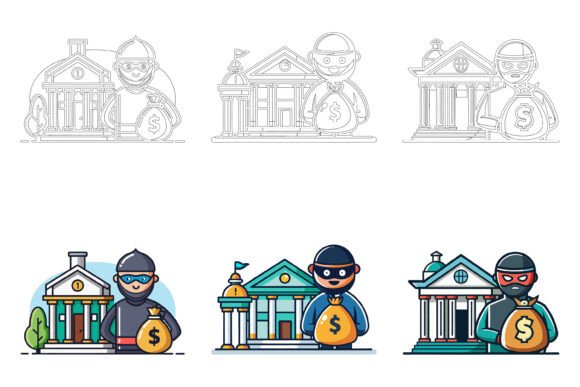
When you need to communicate security concepts, risk scenarios, or financial narratives without using generic stock photos, a well-crafted illustration set becomes invaluable. The Bank Robbery in Safety Vault theme offers a specific visual premise that works across multiple industries—from corporate training materials to creative marketing campaigns. This particular AI EPS collection takes that premise and packages it in a format that prioritizes usability and professional output quality.
What you actually receive is more than a single scene. The file bundle includes AI EPS and JPG formats, designed to function on both Mac and Windows systems without compatibility headaches. The organized file and layer structure means you can open the source file and immediately understand where every element lives—no hunting through mislabeled layers or flattened artwork that locks you out of making meaningful edits.
Why Visual Assets Like Bank Robbery in Safety Vault Matter
Security-related imagery tends to fall into predictable territory. Padlocks. Server rooms. Fingerprint scans. Those have their place, but they lack narrative tension. A Bank Robbery in Safety Vault illustration introduces storytelling elements—conflict, protection, vulnerability, and resolution—that generic security icons simply cannot deliver. This matters when you are building presentation decks, designing infographics, or creating educational content where audience engagement determines whether your message lands or gets ignored.
The narrative quality of this theme makes it particularly useful for industries that need to illustrate abstract security concepts. Financial services firms use such visuals to train employees on fraud detection protocols. Insurance companies incorporate them into client-facing materials about risk assessment. Cybersecurity educators leverage the visual metaphor to explain digital vulnerabilities through physical-world analogies that audiences grasp immediately.
What Sets Professionally Structured Illustration Files Apart
Anyone who has purchased or downloaded illustration sets knows the frustration of receiving a single flattened image or a chaotic file with dozens of unnamed layers. The mention of a neatly organized file and layer structure in this collection addresses that pain point directly. When layers are clearly named and logically grouped, you can isolate specific elements, change colors, reposition objects, or remove components without disturbing the rest of the composition.
This structural consideration extends beyond convenience. It directly impacts your production timeline. A well-organized file might save twenty minutes of sorting through layers per project session. Multiply that across a team of designers working on multiple client deliverables, and the efficiency gain becomes substantial. For solo entrepreneurs and freelancers, that recovered time translates into capacity for additional projects or simply a more manageable workday.
Perfection in Details and Consistency
Detail quality in illustration sets varies dramatically across the marketplace. Some collections prioritize quantity over craftsmanship, delivering dozens of mediocre icons with inconsistent line weights, mismatched color palettes, and sloppy anchor points. The perfection in details and consistency claim signals a different approach—one where each element within the Bank Robbery in Safety Vault illustration receives deliberate attention.
Consistency matters for practical reasons. When you pull elements from a single illustration set into multiple deliverables—perhaps the vault door lands on a website banner while the masked figure appears in a training manual—viewers should perceive cohesive visual language. Inconsistent artwork across touchpoints subtly erodes brand perception, even if your audience cannot articulate exactly what feels off. Professional design teams understand this intuitively, which is why they gravitate toward illustration collections that maintain uniform styling, proportional scaling, and harmonious color relationships throughout every asset.
Practical Applications Across Different Environments
The versatility of a Bank Robbery in Safety Vault illustration extends further than you might expect. Let us walk through realistic scenarios where this type of asset delivers genuine value.
Print Applications
High-resolution JPG formats and vector-based AI EPS files make this collection suitable for physical media. Trade show banners, corporate brochures, safety manuals, and magazine advertisements all benefit from illustration work that maintains crisp edges at any scale. The vector format ensures that scaling up to billboard dimensions or down to business card size produces equally sharp results. Print designers working on security industry publications or financial literacy materials will find the theme immediately applicable.
Web and Digital Media
Website hero sections, blog post featured images, email newsletter headers, and social media graphics all require visuals that communicate quickly in digital contexts. The Bank Robbery in Safety Vault theme grabs attention in crowded feeds because it presents an active scenario rather than a static object. Digital marketers running campaigns around data protection, identity theft prevention, or secure transaction messaging can repurpose illustration elements across multiple platforms while maintaining visual consistency.
Symbols, Apps, and Infographics
Infographic designers often struggle to find thematic illustrations that work at small scales without losing legibility. Well-constructed vector illustrations solve this problem because individual elements can be isolated and simplified for icon usage while retaining semantic meaning. A vault door icon derived from the larger illustration might represent premium features in a SaaS pricing table. A security guard silhouette could indicate authentication requirements in an onboarding flow. The ability to edit, change colors, and modify elements means these adaptations happen within the source file itself, eliminating the need for separate icon purchases.
Customization Capabilities That Actually Matter
Many illustration products promise editability, but the practical experience varies widely. Some require advanced Illustrator skills to make even basic color adjustments. The description emphasizes ease of modification—change colors and modify the icon so easily according to your needs—which suggests thoughtful construction using global color swatches, unexpanded strokes, and well-structured paths. For designers who need to adapt artwork to brand color palettes or client style guides, this accessibility significantly reduces production friction.
Consider a marketing team preparing a campaign for a security audit service. The base illustration might feature a red vault door, but their brand uses a specific blue. With a well-structured file, that color swap happens in seconds rather than requiring manual selection of individual shapes. Similarly, removing or duplicating characters within the scene—perhaps adjusting the number of figures for a specific layout—becomes straightforward when elements exist on separate, clearly identified layers.
Who Benefits Most from This Type of Asset
The audience for professional illustration collections spans roles and industries that might not immediately seem connected. Let us examine specific user groups and their motivations.
Freelance designers and small studio owners value illustration sets because they reduce per-project costs. Commissioning custom illustration work for every client deliverable strains budgets and timelines. A well-made collection serves as a foundation that can be customized sufficiently to feel bespoke for each client while maintaining sustainable project economics.
In-house marketing teams at financial institutions, insurance companies, cybersecurity firms, and legal practices need security-themed visuals regularly but rarely have dedicated illustration resources on staff. Collections like Bank Robbery in Safety Vault fill that gap, providing professional-grade artwork that internal designers can adapt without external vendor coordination.
Educators and trainers developing courses on fraud prevention, risk management, or corporate security protocols benefit from illustration assets that make abstract concepts tangible. Visual metaphors drawn from physical security scenarios help learners connect theoretical principles to memorable imagery, improving knowledge retention and engagement metrics.
Content creators and bloggers covering finance, technology, or business topics use thematic illustrations to differentiate their content in competitive niches. An article about banking security accompanied by generic stock photos communicates less authority than one featuring cohesive, professionally designed visual elements that align with the publication's overall aesthetic.
Evaluating Whether This Collection Fits Your Needs
Before purchasing any illustration set, consider your specific requirements honestly. Do you need security-themed visuals across multiple formats and platforms? Will you benefit from the ability to extensively customize colors and composition? Does your workflow accommodate AI EPS files, or do you work primarily with raster formats? The inclusion of JPG files alongside editable vector formats provides flexibility for team members who may not use Illustrator but still need high-quality imagery for presentations or documents.
Also consider scalability. A single illustration theme might serve your immediate project, but if you anticipate needing related scenes in the future—perhaps additional security scenarios, financial concepts, or risk management visuals—evaluate whether the provider offers a coherent collection that maintains stylistic consistency across multiple purchases. Visual cohesion across an extended campaign or product line strengthens brand recognition and reduces the disjointed appearance that comes from mixing illustration sources.
Implementation Tips for Best Results
When you begin working with Bank Robbery in Safety Vault assets, start by opening the AI EPS file to understand the layer structure fully before making modifications. Identify which elements are grouped, which live on separate layers, and how global colors are applied. This reconnaissance prevents accidental edits that cascade through unintended components.
For web usage, export at appropriate resolutions and consider modern formats like WebP for performance optimization while maintaining the JPG fallback included in the package. For print applications, confirm color mode requirements with your production provider—the vector format supports both RGB and CMYK workflows without quality loss.
When customizing colors for brand alignment, create a swatch palette from your brand guidelines before modifying the illustration. Apply changes systematically to maintain the contrast relationships that make the original artwork visually effective. A poorly considered recolor can flatten depth and reduce the impact of details that the illustrator carefully constructed.
The Bank Robbery in Safety Vault theme also lends itself to sequential storytelling. Consider using elements from the illustration across multiple slides in a presentation deck, zooming in on specific details to guide audience attention through a narrative arc about security challenges and solutions. This technique transforms static assets into dynamic communication tools without requiring animation or video production capabilities.
Ultimately, the value of any illustration collection lies in how effectively it bridges the gap between your communication goals and your audience's understanding. A theme that combines universal recognition—most adults understand what a bank vault represents—with specific narrative elements gives you raw material that adapts to varied messaging needs while maintaining professional polish. Whether you are building a brand identity, developing educational content, or crafting marketing campaigns, the combination of narrative resonance and technical usability makes this type of asset a practical investment in your visual communication toolkit.