How the TV News Anchorman Illustration Set Is Redefining Visual Storytelling for Modern Creators
Visual communication has quietly undergone a seismic shift over the past few years. Audiences no longer respond to generic stock imagery the way they once did. Instead, they gravitate toward illustrations that feel intentional, editorial, and emotionally resonant. The TV News Anchorman AI EPS illustration collection enters this landscape at precisely the right moment, offering something that feels both nostalgic and refreshingly contemporary. But this is not simply about a single character in a suit behind a desk. It represents a much larger movement in how professionals approach visual design, brand storytelling, and content differentiation.
Understanding what makes this particular illustration set significant requires looking beyond the surface. The TV News Anchorman concept taps into collective cultural memory while simultaneously serving forward-thinking design needs. For marketers, entrepreneurs, and content creators who are constantly searching for ways to stand out in saturated digital environments, the appeal is immediate and practical.
Understanding the TV News Anchorman Illustration Concept
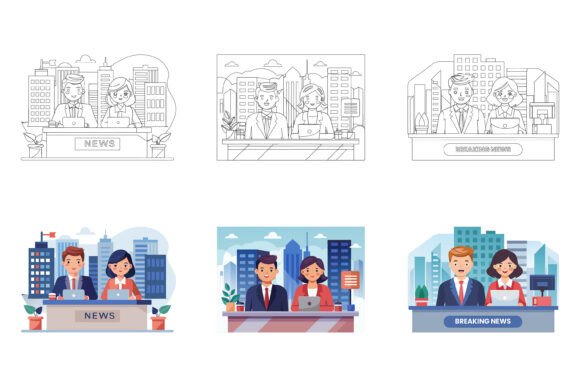
At its core, the TV News Anchorman illustration set is a professionally crafted vector collection that centers on the iconic figure of a television news presenter. The character embodies authority, trustworthiness, and the ritual of information delivery that millions of people grew up with. However, this is not a rigid, single-use asset. The illustration is built for flexibility, allowing creators to adapt the anchorman figure across an enormous range of contexts.
What separates thoughtful illustration design from disposable clip art is the underlying structure. This collection arrives in AI EPS and JPG formats, ensuring compatibility across virtually every design workflow imaginable. The file architecture itself tells a story of professionalism: neatly organized layers, meticulously structured groups, and attention to detail that reveals itself the moment a designer begins to work with the assets. Whether someone is designing for print, web, mobile applications, infographics, or social media campaigns, the illustration adapts without losing its visual integrity.
The TV News Anchorman is more than a character. It is a narrative device. When placed into a presentation slide, a website hero section, or an explainer video thumbnail, it immediately sets a tone. Audiences subconsciously associate the imagery with credibility, breaking news, important announcements, or even satirical commentary, depending on how the designer chooses to deploy it.
Why Visual Professionals Are Paying Attention to Editorial Illustration Styles
There is a noticeable shift happening across creative industries. The clean, abstract, highly geometric illustration styles that dominated the mid-2010s are gradually giving way to something more character-driven and human. Designers are rediscovering the power of recognizable figures, expressive poses, and scenarios that feel pulled from real life. The TV News Anchorman illustration set aligns perfectly with this trend.
Part of this shift stems from audience fatigue. When every SaaS company and startup uses nearly identical flat illustration styles, the visual landscape becomes homogenized. Viewers stop noticing. Engagement drops. The remedy, many creative directors have discovered, lies in illustrations that carry personality, context, and a hint of narrative tension. An anchorman behind a desk is inherently dramatic. It suggests something is about to be communicated. It builds anticipation. These are valuable emotional triggers in marketing and communication design.
For freelancers and agencies pitching concepts to clients, having access to an illustration set that can be edited, recolored, and modified with ease changes the speed and quality of the creative process. Instead of commissioning custom illustrations from scratch — an expensive and time-consuming endeavor — designers can start with a high-quality vector foundation and tailor it to specific brand guidelines. The time saved translates directly into profitability and the ability to take on more projects.
Changing Workflows and Rising Expectations
The modern creative workflow has evolved dramatically. Designers today are expected to move fluidly between print and digital outputs, often within the same project. A single illustration might need to appear on a billboard, a mobile app icon, a social media post, and an email newsletter header. This multi-platform reality demands assets that are technically robust and aesthetically versatile.
The TV News Anchorman AI EPS collection was built with this reality in mind. The inclusion of AI EPS formats means that vector scalability is never an issue. Designers working on massive print layouts can scale the illustration to billboard dimensions without a single pixel of degradation. Simultaneously, the JPG format provides a ready-to-use option for quick web placements and content management system uploads. The design is structured for both Mac and Windows users, removing the friction that sometimes arises when teams work across different operating systems.
Layer organization is another often-overlooked factor that separates professional illustration assets from amateur offerings. When a designer opens a file and finds every element logically grouped and labeled, the editing process becomes intuitive. Changing the anchorman's tie color, adjusting the background, or isolating specific elements for animation becomes a matter of minutes rather than hours. This kind of thoughtful organization speaks to an understanding of how real professionals actually work under deadlines.
Practical Applications Across Industries
The versatility of the TV News Anchorman illustration extends far beyond obvious news-related contexts. Creative professionals are finding applications that the original designers may not have even anticipated. Here are some of the most compelling use cases emerging across different sectors:
- Marketing and Advertising: Brands use the anchorman figure to create mock breaking news scenarios for product launches, limited-time offers, or major company announcements. The visual cue of a news desk immediately signals importance and urgency to viewers.
- Corporate Communications: Internal newsletters, town hall presentations, and training materials benefit from the authoritative yet approachable visual anchor. The illustration humanizes corporate messaging without feeling overly casual.
- Educational Content: Course creators and educational platforms use the anchorman to frame lessons, introduce module summaries, or present key takeaways in a format that feels familiar and structured.
- Social Media Strategy: Content creators on platforms like Instagram, LinkedIn, and YouTube use the illustration as thumbnails, carousel slide headers, and story backgrounds. The news format is inherently scroll-stopping.
- App and Web Design: UI designers incorporate elements of the illustration into onboarding flows, notification screens, and announcement banners. The visual language of news delivery maps naturally onto digital alert systems.
- Infographics and Data Visualization: When presenting survey results, industry reports, or statistical findings, the anchorman figure provides a thematic anchor that makes data feel more narrative and less sterile.
Each of these applications demonstrates how a single, well-designed illustration asset can multiply its value across an organization's entire communication ecosystem. The key is having the freedom to edit, recolor, and adapt the illustration to fit each unique context.
The Value of Editability and Creative Freedom
One of the most frequently cited frustrations among designers who purchase illustration packs is discovering that the files are essentially locked. Flattened layers, embedded raster elements, and poorly constructed vector paths turn what should be a time-saving asset into a time-consuming headache. The TV News Anchorman set takes a fundamentally different approach by prioritizing editability as a core feature.
Being able to change colors means the illustration can align with any brand palette. Being able to modify individual elements means the anchorman can be repositioned, rescaled, or partially extracted for creative compositions. A designer might isolate the desk, the microphone, or the background elements and combine them with other visual assets to create something entirely new. This level of creative control transforms the illustration from a static product into a flexible design system component.
For entrepreneurs and small business owners who may not have access to professional design software, the included JPG format provides immediate usability. The file can be dropped into Canva, PowerPoint, Google Slides, or any basic image editor. Meanwhile, the AI EPS files satisfy the demands of seasoned designers working in Adobe Illustrator, Affinity Designer, or CorelDRAW. This dual-tier accessibility is intentional and reflects an understanding of the diverse skill levels within the modern creator economy.
Connecting to Larger Media and Technology Trends
The enduring cultural fascination with television news — even as media consumption habits fragment across streaming platforms, podcasts, and social channels — reveals something important about how people process information. The anchorman figure remains a powerful archetype. It represents a centralized, credible source of truth in an era defined by information overload and algorithmic content distribution.
Brands and organizations are increasingly leaning into this archetype as a way to cut through the noise. The visual shorthand of a news broadcast instantly communicates that what follows is worth paying attention to. This makes the TV News Anchorman illustration particularly valuable for companies operating in industries where trust and authority are competitive differentiators: financial services, healthcare, legal services, education, and B2B technology.
At the same time, there is a growing appetite for illustrations that do not take themselves too seriously. Depending on how designers choose to style and contextualize the anchorman, the same asset can convey gravitas or playful irony. A startup might use a brightly colored, slightly exaggerated version of the anchorman to announce a ridiculous product feature. A nonprofit might use a more subdued, realistic version to deliver an impact report. The creative possibilities are dictated by the designer's vision rather than the limitations of the asset itself.
Why Perfection in Details Matters
Audiences may not consciously notice the quality of vector curves, the consistency of line weights, or the harmony of a color palette. But they feel the cumulative effect of these details. Illustrations that are slightly off — uneven spacing, awkward proportions, inconsistent styling — create a subconscious impression of amateurism that reflects poorly on the brand using them.
The focus on perfection in details and consistency within the TV News Anchorman collection addresses this directly. When a design asset is built with precision, it elevates everything it touches. A presentation slide looks more polished. A website feels more trustworthy. An advertisement appears more professional. For businesses and creators competing in markets where visual credibility directly impacts conversion rates and audience growth, this attention to detail is not a luxury. It is a strategic necessity.
Consistency across the file set also means that designers who purchase multiple illustration packs from the same collection can combine them seamlessly. The anchorman can coexist alongside other characters, scenes, and symbols without visual dissonance. This scalability is important for brands that plan to build extensive illustration libraries over time.
Making the Decision: Who Benefits Most
The TV News Anchorman AI EPS illustration set is not a niche product for a narrow audience. Its applications span a remarkably wide range of professional contexts. Marketing teams looking to refresh their visual assets for upcoming campaigns, freelance designers building client presentation decks, content creators seeking distinctive YouTube thumbnails, and app developers designing notification interfaces can all extract immediate value from the collection.
Entrepreneurs launching new ventures often find themselves in a difficult position. They need professional-grade visual assets but lack the budget for custom illustration work. A well-crafted, editable illustration set bridges this gap elegantly. It provides a level of quality that feels custom without the associated cost and timeline. The fact that the files are designed to work on both Mac and Windows environments further reduces friction for teams operating with mixed technology stacks.
Ultimately, the decision to incorporate an illustration set like this into a creative workflow comes down to recognizing the compound value of versatile, well-structured design assets. The time saved on a single project through efficient file organization and easy editability can justify the investment. Across dozens of projects, the return becomes exponential. And beyond the practical considerations, there is the intangible benefit of working with illustration assets that genuinely inspire creative exploration rather than constraining it.
In a visual culture that rewards distinctiveness and penalizes genericism, the TV News Anchorman collection offers a compelling proposition. It is not simply an illustration of a person behind a news desk. It is a storytelling tool, a brand-building asset, and a creative catalyst — all wrapped in a format designed to respect the way modern professionals actually work.