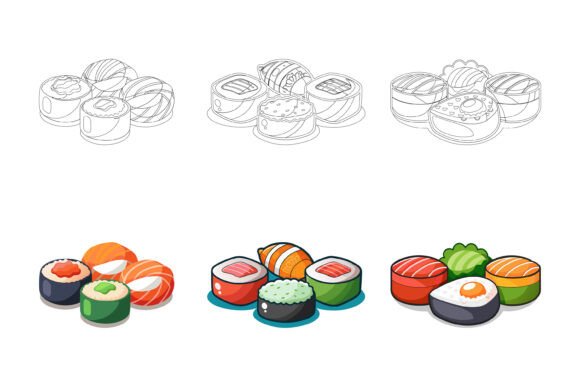
Japanese Food Models: Evaluating Their Utility for Design and Display
The visual language of food carries enormous weight. From restaurant menus and culinary blogs to packaging and app interfaces, the way dishes are presented can make or break a viewer’s reaction. Among the options available to designers and business owners, Japanese Food Models—particularly digital illustration collections—have emerged as a distinctive and practical tool. Rather than viewing them as a simplistic shortcut, a deeper evaluation is necessary. This article examines what these resources are, the scenarios where they provide genuine value, their inherent tradeoffs, and how to determine if they align with your project’s specific goals.
Understanding What Digital Japanese Food Model Collections Offer
In physical form, Japanese Food Models are the hyper-realistic displays commonly seen in restaurant windows across Japan—made from wax, plastic, or resin. The digital iteration transforms this concept into vector and raster illustration sets. These collections typically contain meticulously crafted representations of sushi, ramen, tempura, bento boxes, and other iconic dishes. Instead of commissioning custom photography or arranging live food shoots, which are costly and logistically complex, designers can open a file and access ready-made, editable visuals.
What distinguishes a well-organized digital collection? The structural qualities matter significantly. A comprehensive set will include multiple file formats: AI (Adobe Illustrator) and EPS for scalable vectors, and JPG for quick raster previews. This cross-compatibility ensures you can work fluidly on both Mac and Windows environments. The internal organization is equally critical. Layers are named logically, colors are separated thoughtfully, and objects are grouped without being merged unnecessarily. This allows you to isolate a single grain of rice or a slice of tamago, adjusting its appearance independently. Such precision in file and layer structure is not just a convenience; it directly impacts how efficiently you can bring a design to completion without fighting the source material.
Weighing the Practical Benefits
When you strip away marketing language, the practical advantages of these AI EPS illustration sets become clear. They solve specific pain points in creative workflows.
- Rapid Conceptualization: For building mood boards, pitching ideas to a restaurant client, or populating wireframes, a library of food icons accelerates the process and communicates concepts before any heavy investment in custom work begins.
- Consistent Branding: A well-designed set maintains perfection in details and consistency across every piece. Whether you use a soba noodle bowl on a website header and a matching icon on a mobile app, you avoid the jarring mismatch that can happen when photos are sourced from different studios.
- Multi-Platform Suitability: Because the files are vector-based and editable, you can use the same asset for a large-format print menu, a social media graphic, an infographic detail, or a favicon. Resizing does not degrade quality, and you can modify the iconography to fit narrow space constraints.
- Effortless Customization: The phrasing “change colors and modify the icon so easily” points to a genuine benefit. If your brand palette shifts, you do not need to re-source visuals. Global color swatches in AI or EPS files let you recolor an entire ramen illustration with a few clicks, ensuring harmony with your layout.
Scenarios Where Japanese Food Model Illustrations Excel
These resources are not a universal solution, but they shine in specific, high-frequency situations. If you operate a food blog and need a consistent thumbnail style, a vector sushi set provides uniformity that user-generated photos cannot. For a small sashimi restaurant’s takeaway menu, using stylized, clean illustrations can convey the offering more clearly than poorly lit phone photos. In app development, where screen real estate is tight, the icon-quality simplicity of well-designed food symbols aids navigation without overwhelming users.
Another strong fit is instructional or infographic content. Visualizing a recipe step-by-step or explaining the components of a kaiseki meal becomes more digestible when rendered as clean, layered illustrations. The ability to edit, change colors, and modify elements means you can highlight the key ingredient without distraction. For non-profits or educational platforms discussing nutrition, customizable food groupings are far more adaptable than stock photography.
Recognizing Tradeoffs and Key Considerations
No resource is without limitations. A critical evaluation requires acknowledging what you might sacrifice by choosing a digital AI EPS collection over other methods.
- Uniqueness and Brand Differentiation: The most popular collections may be used by many businesses. Without significant modification, your ramen icon could look indistinguishable from a competitor’s. A reliance on out-of-the-box assets risks diluting a brand identity that should be distinctive.
- Emotional Resonance: Photographs of real food can evoke texture, steam, and a visceral sense of appetite that flat or even shaded vector illustrations struggle to match. For a fine dining establishment’s website, glossy high-resolution photography often conveys the luxury and atmosphere expected by the clientele in a way that modeled graphics may not.
- Editing Proficiency Requirements: While the files are “suitable for print, web, symbols, apps, infographics,” unlocking their full potential demands a working knowledge of vector editing software. If you need to dramatically alter the shape of a nigiri or restructure a bento box, you must be comfortable using Adobe Illustrator or similar tools. A novice user looking for a completely unedited drag-and-drop solution might find the learning curve steeper than anticipated.
- Contextual Mismatch: A playful, stylized illustration style might not align with a brand built on rustic, artisanal authenticity. If your café prides itself on its organic, sunlit brunch atmosphere, hand-drawn watercolor elements or heavily stylized photography could feel more cohesive than precision-cut vectors.
Evaluating Alternatives and When to Look Elsewhere
To make a fully informed decision, place Japanese Food Models alongside the available alternatives. Commissioning a custom illustration set is the clearest path to an utterly unique look. This is a higher upfront investment but eliminates the risk of visual repetition. The result is tailored exactly to your brand’s narrative, proportions, and color systems. If your project involves a flagship menu or a core brand identity, this path often justifies its cost.
Stock photography offers another route. The quality of food stock photos varies enormously, with high-end platforms offering stunning, lifestyle-oriented imagery. The downside is a loss of control; specific angles, plating, and ingredient combinations are hit-or-miss. A mixed-media approach can be powerful. You might use vector food icons for UI elements but pair them with original photography for hero banners. 3D rendering has also become accessible, allowing you to construct and light photorealistic food entirely within software, delivering the control of illustration with the volume of photography.
If your need is immediate, the budget is constrained, and speed-to-market matters, a well-organized AI EPS pack is a rational tactical choice. It is the option that best balances quality, editability, and cost in many mid-tier projects. Conversely, if the food visual is the absolute centerpiece of your project’s emotional appeal, short-changing it with a generic graphic could undermine the entire effort.
Making a Confident, Informed Choice
Your ultimate decision should hinge on a clear-eyed assessment of your project’s functional requirements and emotional goals. Before you select any resource, examine the sample images or previews thoroughly. Ask whether the artwork’s inherent style—its line weights, chosen color palettes, and level of detail—aligns with your other brand assets. Explore whether the file structure truly supports your workflow. The promise of being neatly organized with a clean layer structure saves hours of frustration during editing, so validate this claim where possible.
Consider the long-term trajectory. If you merely need a quick turnaround for a low-budget social media campaign, the cost-benefit analysis tilts strongly toward a versatile, multi-format set like the AI EPS collections described. If you are building a new brand from the ground up and food is your product, the pressure to be unmistakably original may push you toward bespoke creation. There is no single right answer, only the best match between a resource’s strengths and a project’s priorities. By evaluating Japanese Food Models through this practical, no-hype lens, you position yourself to choose a tool that genuinely supports your creative vision rather than one that merely fills a gap.