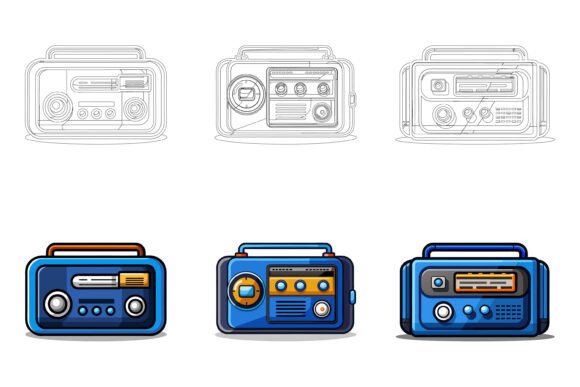
Set of Retro Radio Cassette Illustrations for Designers
Vector illustration sets often promise a lot, but few actually deliver the kind of polished, ready-to-use detail that makes a real difference in a project. The Set of Retro Radio Cassette from the special AI EPS collections stands out because it was built around a single, iconic object and refined until every curve, shadow, and control button felt both nostalgic and perfectly modern. Whether you are updating a podcast cover, building a music festival identity, or creating a vintage-inspired mobile app icon, having access to a carefully organized collection of radio cassette graphics can save hours of searching and give your work a consistent, hand-finished look that clip art simply cannot match.
These aren’t generic music silhouettes. The collection focuses entirely on the retro radio cassette form — from classic boombox designs to compact portable cassette players — allowing you to pull a whole visual language from one source. Because the files arrive as AI EPS vectors with a companion JPG preview, you can open them on virtually any modern design tool on Mac or Windows and start working within seconds. The underlying structure is what really makes the set a reliable asset, and that’s what this article explores in depth.
Why Vintage Audio Equipment Still Carries Visual Weight
For many people between 30 and 50, the cassette player and the boombox represent more than a piece of hardware — they are shortcuts to entire decades of music culture, street style, and personal expression. Using a retro radio cassette in a design instantly triggers warmth and familiarity without needing a long narrative. Marketers building campaigns for throwback events, bloggers writing about analogue revivals, or small business owners launching retro-themed product lines all lean into this specific imagery because it communicates instantly and across languages. A well-drawn vector illustration of a retro radio cassette does this more cleanly than a photo, because you can strip away background noise and keep only the essential geometric charm of the device.
That clarity is especially useful in app icons, infographics, and printed flyers, where a photo might feel too busy or dated. An edit-friendly AI EPS file lets you simplify the design even further — turning a detailed boombox into a flat, two-tone symbol for a website header, then bringing back the depth and shading for a poster. The retro radio cassette becomes a flexible visual anchor that you can adapt without losing its identity.
What a Truly Organized Illustration Set Saves You
Anyone who has downloaded free vector packs knows the frustration: layers named “Path 1,” grouped objects that refuse to ungroup cleanly, and colours that seem to demand a forensic investigation. The Set of Retro Radio Cassette avoids this by providing a neatly organized file and layer structure. Each component — the antenna, tuning dial, cassette door, buttons, speaker grille — lives on a logically named layer, often separated into groups so you can isolate, hide, or restyle parts without unraveling the entire illustration. For professional designers, this organisation means the difference between a quick 10‑minute edit and an hour of tedious click‑and‑delete cleanup.
Educators creating learning materials also benefit. When you want to highlight specific parts of a device in a tech history lesson or a product design class, you can show and hide elements layer by layer, visually explaining how the mechanism worked. That educational value becomes possible because the file was structured with clarity in mind, not just as a final flattened image.
Perfection in Details That Actually Communicate
“Perfection in details” can sound like marketing fluff, but in vector illustration it means something concrete: consistent stroke weights, aligned symmetry, proper corner rounding, and deliberate use of highlights. A retro radio cassette has many repetitive small elements — speaker dots, equaliser sliders, tape spools — and if these are even slightly inconsistent, the whole illustration looks careless. This collection maintains consistency across every variation of the radio cassette, so when you place a boombox next to a smaller Walkman-style player in a layout, they feel like parts of the same family, not a random mismatch.
That consistency is critical for infographics and multi‑panel presentations. If you are comparing audio formats across decades, using a mismatched set of icons undermines the professionalism of the data. With polished, uniformly treated retro radio cassette illustrations, the focus stays on your message, not on visual hiccups.
Editable Colours and Shapes Mean You Own the Result
A common hesitation with pre‑made illustrations is that they force you into someone else’s colour palette. It might be neon pink and electric blue when your brand is muted olive and beige. The design here puts control back in your hands. Since the AI EPS files are fully vector, you can change colours, adjust the weight of outlines, and even reshape the silhouette of the radio cassette to match your project’s tone. Need a minimalist line-art boombox for a sleek lifestyle blog? Reduce the strokes and remove fill colours. Need a bold, high‑contrast version for a tee‑shirt graphic? Boost the stroke width and flatten the shading. You are not remaking the illustration from scratch; you are adapting a high‑quality base that already has the right proportions and vintage character.
Freelancers and small business owners often find this adaptability saves money because they don’t need to commission a custom icon set for every small campaign. One purchase of a versatile retro radio cassette set can later morph into icons for social media, a hero graphic for a landing page, and an insert for a product manual — all looking distinct but unmistakably connected.
Cross‑Media Suitability Without Extra Export Headaches
Many graphics libraries excel in one medium and crumble in another. A design that looks glorious on a Retina screen might print with jumbled edges, or an EPS file built for large‑format banners might contain overly thin lines that vanish on a mobile app icon. The retro radio cassette illustrations here are described as suitable for print, web, symbols, apps, and infographics — and the vector foundation makes that promise achievable. Because the artwork scales infinitely without losing sharpness, you can drop the same boombox graphic into a billboard design (300 dpi, large dimensions) and a 24‑pixel‑tall app icon, tweaking the level of detail as needed.
This cross‑media flexibility is especially valuable for marketing teams who need to roll out a consistent identity. A podcast network, for example, could use the retro radio cassette as the core brand mark: full‑colour and detailed for the website masthead, simplified for the favicon, and inverted to white for merchandise labels. The JPG preview files also help non‑designers quickly place the artwork into presentations or documents without needing vector software, making the set accessible across a team.
Real‑World Use Cases That Go Beyond the Obvious
It’s easy to picture a retro radio cassette on a music event poster, but the value reaches further. Consider these practical situations:
- Podcast cover art – A cassette illustration immediately signals an audio‑focused show, and the editable layers let you incorporate the show’s name inside the cassette label.
- Mobile app onboarding screens – A series of vintage audio devices can introduce features for a music player or podcast app, creating a warm, lo‑fi mood.
- Educational infographics – A timeline of portable music history benefits from consistent device illustrations; you can highlight the radio cassette era with a set that matches your other vector icons.
- Membership site badges – Communities built around retro music genres can use the cassette as a reward graphic or profile badge, changed to the member’s favourite colour.
- Printed workshop materials – Meditative or nostalgia‑based workshops (like “mixtape memory” events) can use clean, printable elements in handouts and wall art.
In each of these, the outcome isn’t just a nicer picture; it’s a more coherent experience for the viewer. The retro radio cassette stops being a decoration and becomes part of the storytelling.
Who Stands to Gain the Most
While anyone with basic design software can use these files, certain groups will find the fit almost seamless. Freelance designers and small studio owners who juggle multiple client styles can rapidly prototype identity options by recolouring and rearranging cassette elements, cutting the concept phase significantly. Bloggers and content creators with light design experience can import the JPG or EPS into Canva or Affinity and produce shareable social graphics that don’t look off‑the‑shelf. Print‑focused businesses — from zine publishers to vintage clothing stores — can rely on the professional layering for screens, vinyl cuts, or foil stamp separations without extra file prep.
Even marketers buried in performance campaigns can benefit. When a campaign needs a quick nostalgic asset for a limited‑time offer, the editable nature of the set means the same retro radio cassette can be adapted for dark‑mode email banners, light‑mode landing pages, and animated Instagram posts, all while maintaining the brand’s accent colour. That agility reduces dependency on external designers for every small asset variation.
Things to Keep in Mind Before Jumping In
No illustration set fits every scenario. The retro radio cassette vector pack requires some familiarity with vector editing tools — Adobe Illustrator, CorelDRAW, Affinity Designer, or free alternatives like Inkscape. If you plan only to use the JPG previews and never touch the AI EPS files, you will miss the deeper editing potential. Additionally, while the detail level is high for flat and semi‑realistic styles, these are not 3D models or ultra‑photorealistic renders. If your project demands cinematic realism with drop shadows mapped to actual perspectives, you might need to supplement with other resources. However, for the vast majority of print, web, and app needs, a clean vector aesthetic communicates more clearly than over‑rendered imagery anyway.
Another nuance is the theme’s specificity. The collection centres entirely on the retro radio cassette, which is a strength if that’s the era you want to evoke. If you need a broader range of vintage items — turntables, vinyl records, microphones — you may want to confirm that this set alone covers your needs or that you can mix it with complementary vectors. But for projects where the cassette is the hero, having a dedicated, well‑resolved set prevents the mishmash that often happens when grabbing individual icons from different sources.
Making the Illustration Work Harder in Everyday Workflows
Instead of considering the set a one‑time download, think of it as a reusable kit. Save a “master file” with all original layers intact, and for each project, duplicate it before making changes. This habit preserves the base artwork and allows you to build a small library of branded versions over time. Tag your variations with the colour code or campaign name, and you’ll have a quick‑access resource whenever nostalgia‑themed content is needed again. For teams, placing the files in a shared Creative Cloud folder or a company asset manager lets multiple people repurpose the same retro radio cassette in social posts, email headers, and presentation decks without drifting away from a unified style.
When designing for accessibility, the vector format also helps. You can increase contrast, thicken strokes for low‑vision readability, or convert decorative elements into simplified forms while retaining the recognizable silhouette — all without losing file quality. Not every visual asset offers that level of control.
Why the File Format Choice Actually Matters
The combination of AI, EPS, and JPG might seem standard, but it reflects a practical understanding of how people work. The native AI file preserves layer names and editability for Adobe users. The EPS format offers broad compatibility across older software and niche printing tools. The JPG provides a quick visual reference and a fallback for environments where vectors aren’t accepted. Having all three together means you aren’t forced to convert or export immediately; you can pick the format that matches your current step — quick mock‑up, final vector clean‑up, or press‑ready output — with the confidence that the original detail hasn’t been compromised.
Ultimately, the Set of Retro Radio Cassette illustrations exist to solve a specific creative challenge: how to get a professional, evocative, and consistently styled vintage audio visual without starting from a blank canvas. When the files are this organized and purpose‑built, the time you invest shifts from tedious construction to thoughtful adaptation, and that shift almost always leads to stronger, more audience‑focused design outcomes.